
Substack Has a MAJOR Problem...
... and it won't be resolved by calling for account take-downs by anyone you label as a sexist, racist, or any other kind of bigot.

As someone who has already produced two articles covering two prolific, toxic Substackers on my page (on either side of the political aisle), and who engages with a very broad audience on this platform, I think it’s time I addressed the censorious plea coming from (mostly) social ‘progressives’, feminists, pseudo-liberals, and the more radical Antifa calling for account take-downs. Censorship under this method is a disingenuous and ineffectual stratagem to take, which I will later explain why. For now, I will discuss the crux of the issue. First, let’s take a look at some example arguments made by some of the individuals calling for account bans.
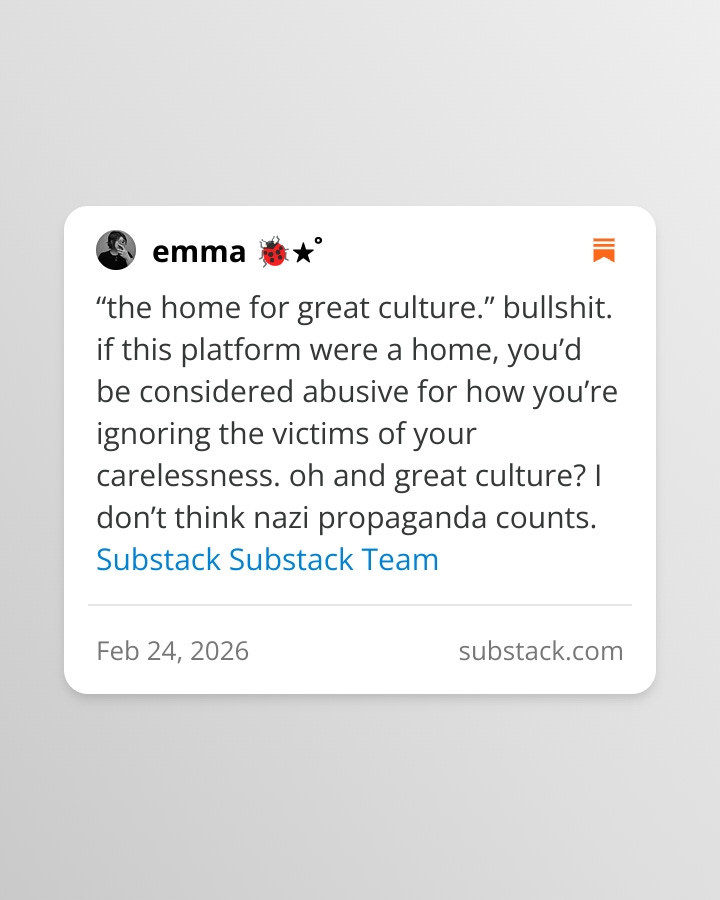
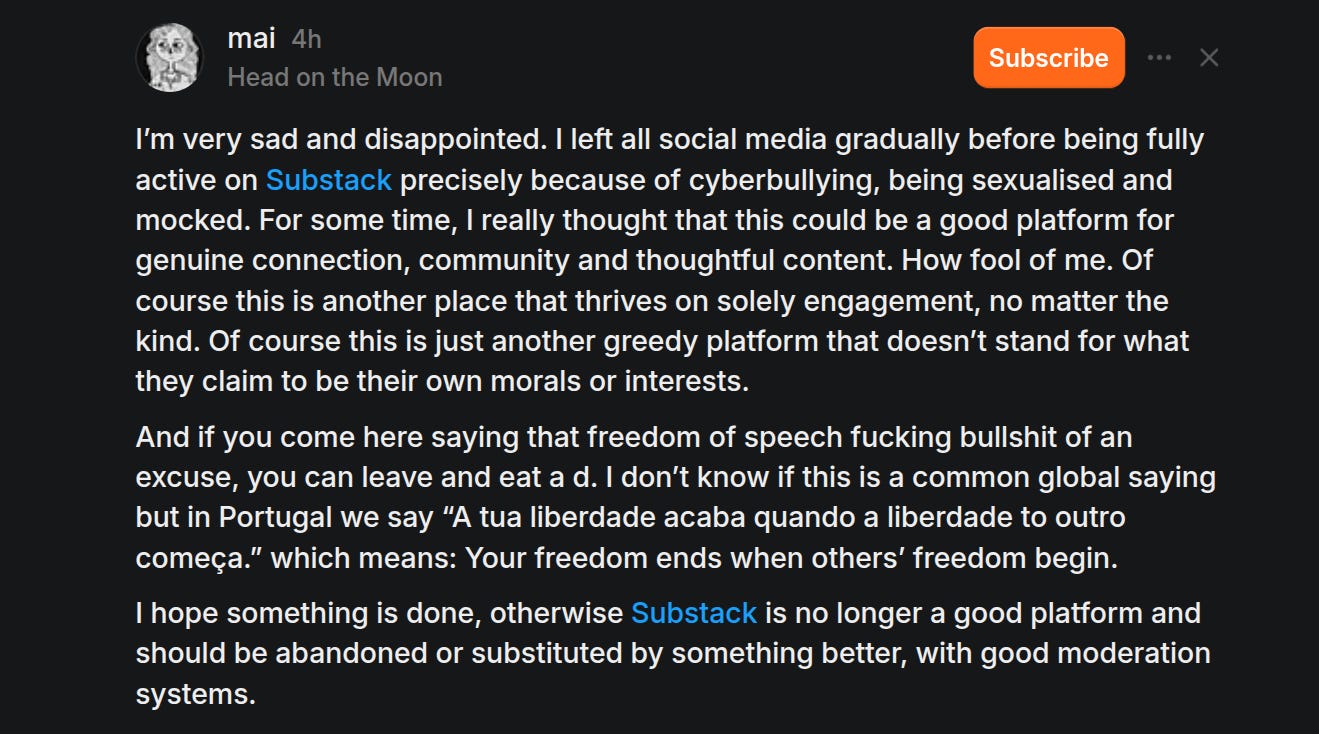
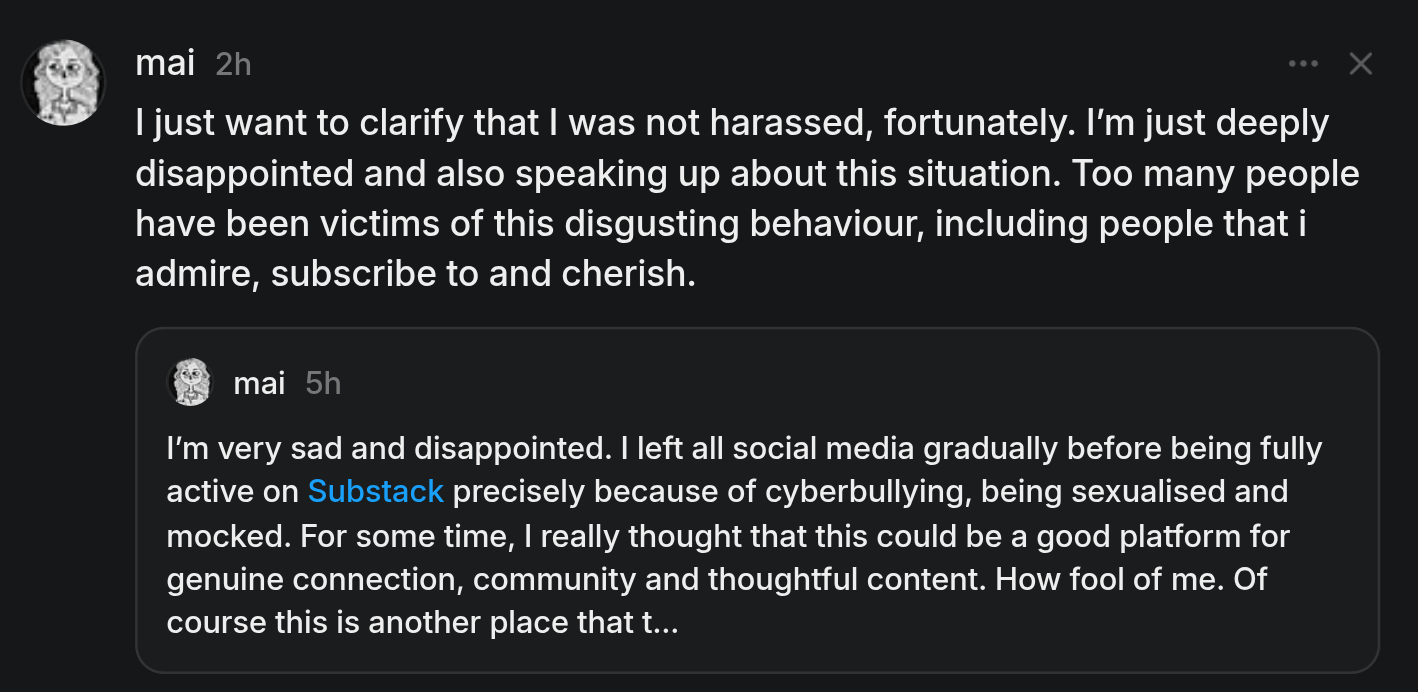
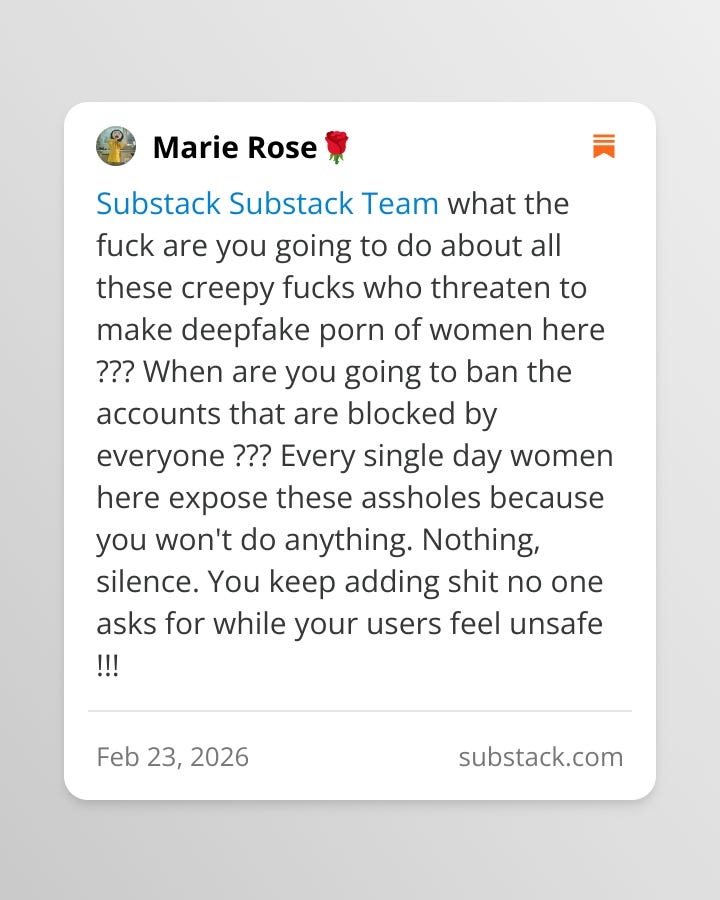
Reconciliation
I would first like to preface my response to these notes with genuine empathy. No one should ever experience the kinds of repugnant, degrading abuse that women are receiving on these platforms from worthless, genetically diseased men with neither the intellect nor wit to interact with them at any level past morbid, barbaric harassment. Ironically enough, it’s these sorts of sophisticated women in high-paying jobs who contribute towards the benefit hand-outs being dealt to these basement-dwelling, unemployed freaks. I will further clarify that targeted harassment (which by definition is an act without consensual participation from the recipient party), goes beyond a good purview of freedom of speech. Harassment includes acts such as sending death/rape threats, using deep-fake technologies to harass/humiliate individuals with, doxxing through sourcing non-public information, and repeated harmful engagements with someone who neither provides consent, nor who implies consent via reciprocal harmful counter-engagement. Clearly, the Substack moderation team are not doing enough to punish genuine incidents of harassment, and so much of these calls are valid.
Generally, if you call someone a stupid fat cunt because they posted a comment which expresses itself with non-violent language, and if they decide to report that comment over responding back with equal harshness, then your account should be flagged with a warning. Repeated misconduct should then lead to a ban. In these cases, context and the severity of the act itself should always matter. To that end, if a woman punches a man after repeated, severe verbal harassment, as should be the case if a man hits another man under the same circumstances which ought to be regarded as a retaliation to bullying, then it’s justified. Thus, it should be treated as a legally inactionable escalation of a social drama that, under the same perspective of implied consent, the perpetrator gave through acceptance of the risk they took when choosing to bully someone. Of course, so long as any police inquiry found no fault or excessive retaliatory force was employed, etcetera, etcetera… Having now established my conciliatory preface, I will now move onto the nuance of where the logic of these statements die.
A Critique of Blanket Censorship
The problem with the logic I have seen in the mass of similar notes here is that they’re not differentiating between harassment and perceived unjustified bigotry (some so-called ‘bigotry’ based on puritannical definitions that people generally express as an evil, such as Islamophobia, is in fact justifiable where the discrimination rests of harmful Islamic culture), and what the means and consequences of such bigotry entail. This shouldn’t result in Substack actively monitoring accounts (besides for the direct purposes of using sophisticated and secure AI tools to detect content which in itself is illegal, such as CSAM, plagiarism, conspiracy with criminal intent, etcetera) on the basis that they express opinions which are considered to be in themselves repugnant. The reason for this is because such a stratagem only has real social utility for the expressed purposes of ex ante censorship, whereby accounts would be terminated on the basis that their values would, not could, lead to social harm because they do not accord to the principles of the liberal establishment. Such censorship will always require greater social harms to induce, and the reality of its effects dispels the Popperian logic behind the ‘paradox of tolerance’. It’s easy to envisage the chilling effect that may ensue as a result of lawfare, which absorbs false-positive instances of divisive opinions over actual harassment.
First, the group that imposes intolerant policies unto other groups that itself regards as intolerant is only minutely plausible at best when the progenitor group has perfected its own principles of tolerance. However, given this argument is almost exclusively imbued in this debate of censorship, and the facticity that pseudo-liberal institutions are actively suppressing the freedoms of anti-establishment ‘dissidents’ (i.e. the thousands of people arrested over ‘offensive tweets’, digital ID, and being labelled as a ‘potential terrorist’ by security/intelligence services on the grounds of expressing cultural nationalism [I myself am an anti-nationalist, but I have the moral and logical consistency to express disgust with this outrageous doctrine]), illustrates how desperate, unfair, and authoritarian so-called liberal democracies have become. Universally, societies where its people are barred from expressing its socio-political attitudes become less refined, less intelligent, and more compliant to the tyranny that’s killing off its humanity.
Of course, Popper’s logic was more so in reference to restricting political movements that wanted to overthrow the state—that did in fact provide freedoms of speech—to replace it with a new totalitarian regime. For example, this would mean that even if such a party were elected, the state would be able to arrest its members who tried to amend/repeal constitutional laws which guarantee aforementioned basic liberties and freedoms that are integral to the formation of the state itself. To an extent, I agree with this measure under certain circumstances. Although, the problem, again, is that this justification is rarely the case in praxis. Combined with a post-modern ether of purist, anti-harm reductionism, what constitutes as intolerable on the basis of subjective qualia is both valid, and determines real-world social harm that is indivisible unto the individual that it impacts.
Popper’s paradox of intolerance carries a spillover effect that, naturally, is applied to all other areas of public policy where power is recognised as a social factor. That is to say, a person who harms another with their speech must be penalised and ‘re-educated’, because they as an indivisible actor, wields social influence that could jeopardise the liberal establishment. Apply that logic to pre-concieved beliefs about gender, sex, and race, regardless of your opinion’s objectivity, then the conclusion becomes one of the same. This discounts any form of suffering that could hold good social utility and personal development (heartache is a necessary part of maturing, building resilience in difficult situations creates more rational, reasonable people, etcetera), and defines politics based on who are the ‘meanies’, and who are the ‘lovelies’.
The Main Consequences of Censorship
So, not only is a censorship model unjust owing to its disproportionate unfairness over who is targeted by groups which may/may not find certain statements more offensive over others, to incentivise those groups to deplatform others reinforces a hive-mindedness which collectivises opinions over balancing them with individualist interest. Imposing censorship will create two deeper, far more parasitical, harmful consequences inherent to this model:
It isolates and forces radicals to communicate ‘underground’, on less regulated platforms. Just because you’re not seeing them, it doesn’t mean you’re safe from them, and that society has somehow rid itself of them. This prevents them from being able to be deradicalised, while compounding their biases as holding informational social influence because to them, they are banned because no one wants to debate them, because no one can beat them in an argument. This makes the so-called liberal appear both hypocritical, and irrational—especially to apolitical folks who are witnessing these culture wars unfold on the sidelines. This would give people like Elijah society (one such lolcow troll I have covered in a previous article) a cause célèbre to legitimise his claims, while his ‘le epic troll’ works because it self-evidently triggers people. This only makes him more determined, and does nothing for everyone else. This mentality occurs with everyone, irrespective of their political persuasion, because denying a person’s right to freely express their views (with some obvious limits such as inciting real-world violence, CSAM, doxxing, etc.), however abhorrent they are, creates unfairness. Ergo, I will never report people like Elijah, unless their speech goes beyond the pale of the aforementioned liberty.
It erodes social trust, and socio-political cultural development. When people are actively monitored by institutions, and by others in their social circle with the ability to call upon higher powers at the slightest social infraction, results in either the individual self-policing their language to conform to the breed of language that others impose (despite still holding non-conformist private beliefs), and/or it will result in disorder when the individual becomes conscious of their tyranny. There is a reason why a polite society is beloved by those who partake in it, over the vagrancy of ‘woke’ linguistics. A polite society affords its own niceties and social cooperation by its members who are able to foster closer, more genuine relationships on the basis of shared passions within an aesthetically appealing location, maintained by its darlings. A gathering of HR and pseudo-liberals force themselves into using a superficial language which is built on virtue-signalling, backstabbing, and artificial demeanours to make them appear compassionate. This regresses genuine socio-political development because more effort is wasted into the optics of doing anything over the actual action of doing what is right.
Imposing censorship in this way is a self-defeating practice. The reality of how these kinds of discursive practices operate online when tackling trolls and online bullies mean that winning over/dominating the ideas of these people involves heavy-handed language. Trolls are clearly stimulated through bullying, and while they are not akin to the mafia, they are socially organised in a cartelised fashion. Attempting to de-cartelise social groups in this way without allowing the self to use the discourse practices necessary to combat yet again will prove ineffectual. Trying to engage with the trolls on an exclusively rational, poetic, or even empathetic level won’t do anything; cyberbullying the cyberbully, however, through ‘owning’ and repetitiously chastising him certainly will make them stop. Some might bring down their irony-poisoned walls and open their floodgates to reason, but I can assure you most of them won’t. Most of them care too much about their petty online reputation as ‘le epic troll’ to care.
Redressing the Presence of Extremist Ideology
What I am yet to mention is the specific presence of Nazi ideology, White supremacy, and other deeply anti-Semitic materials published on Substack, and how Substack’s hands-off approach to not deny payments to donors subscribed to such content gives them a workable business model. In plain terms, I will: defend Substack’s right to make this decision; note the double-standards in the advocacy with this concurrent movement to threaten the Substack with boycott (while also defending the boycotters’ own right to boycott the platform), and why it will be as self-destructive as all other forms of polarisation have been. For reference, I will link two articles that express in the broadest possible basis to deplatform these individuals:


First, Substack has this fundamental right not just because it exists as a business which fundamentally relies on a consensual social contract for people to use (accepting its terms and conditions of service), but I believe its actions are just, because as a platform, it is bridging the gap between groups who would otherwise be vengefully antagonising each other across different platforms and echo chambers. There will be initial tensions, but so long as Substack gets together effective moderation where it is necessary (based on aforementioned issues of cyber sexual harassment), these things should die down when these groups are forced on the same platform to interpolate. Moving away from this platform will not reduce the number of people holding reprehensible worldviews, and it is rather audacious to feel such entitlement to tell Substack’s owners what they can or can’t do with their platform on a basis of someone else’s opinions causing offence. If you want to live in an echo chamber, then…

Second to that, there are major double-standards in the calls to ban people labelled as the ‘enemy’ of collectivised echo chambers, because of belief systems regarded as pernicious in and of themselves as an anti-thesis to what is considered acceptable in a hypocritical Overton window. These hypocrisies are real because the perception of any anti-thetical belief is reductive, subjective, and influenced by meta-narrative. For example, while I constantly hear concerns raised over the platforming of Nazis and white supremacists on Substack, I am yet to hear the same concerns raised over Black Power publishers, self-proclaimed misandrists, and fundamentalist Islamism. If you’re reading this as one such person who has selectively raised such concerns, then you’ve likely already judged me to be some paleoconservative dinosaur, or perhaps an an-cap freak. You couldn’t be farther from the truth, and you ironically reveal more about yourself than you do me.
This unconvincing advocacy is what pushes more people to the far-right: removing any means of communicating salient issues, irrespective of its credibility, over a fear of legitimising such concerns and being labelled as one yourself, is both a symptom of a pervasive neoliberal hegemony that defines a person based on algorithmic optics, and it kicks the can further down the road. Part of the problem is that people are judged for too heavily for communicating with people whom others find disagreeable. Of course, it is everyone’s right to boycott a product/service if they find its actions intolerable, but is equally within my right to criticise the boycott as a fool’s errand. Leaping from one platform to another will simply leave Substack in a worse state; giving the far-right another media platform to control and exhort their destructive worldviews. You can’t contain this onto a platform when the domain itself exists on web browsers that advertise its content across the internet. Ergo, if you regard the far-right as an evil that needs to be eviscerated, then based on your own moral values, it is a moral obligation for you to contribute to a discourse practice of persuasion that leads to social change.
As for any/all criticisms surrounding Substack’s monetisation of Nazi propaganda, this is a literal consequence of the economic reality we have developed within discourse production. When discourse expresses itself in material that does not cause harm as an ends on its own/through its means of materialisation (where harm is defined by common, discernable victimisation), then its commercialisation as legal tender should not be infringed upon, and is only economically fair to enable everyone that opportunity to do so. For the same reason that Amazon should be able to profit from selling copies of Mein Kampf, the prospect of economic gain is a non sequitur argument that should not interfere with moral issues over the distribution of permissible content that is not conditional to inherent economic malfeasance. Simply put: Substack is a for-profit organisation must make money to survive, and so the debate must be constrained to the service itself when the issue is not based on financially exploitative practices. Hence, my argument rests upon the injustice that follows when discourse is banned on the grounds of its own extremist content, socio-political culture concentrates, stagnates, and then regresses.
Holding Better Discourse
For anyone reading this, your Substack platform is yours to cultivate of your own volition, so I’m not asking anything specific from you. If you cannot personally tolerate the obsessed trolls, then it’s your choice to block them, and delete their comments. However, that shouldn’t mean others can’t engage with them. There’s a reason why actual giga-liberals such as John Rawls, Susan Moller Okin, Rowan Atkinson, George Carlin, and Ricky Gervais (yes, it’s a tragedy when three of our contemporary finest liberal individuals I’m naming are better-known for their comedy) are beloved for their political messaging, over the pseudo-liberals among the likes of the Clinton’s and the Starmer’s of the world. One group supports free speech through acknowledging context of words that are otherwise neutral on their own, while the other regards speech as inherently offensive or inoffensive, depending on who you are and whose side you are on.
So, as I position myself online as someone who will engage with people on all different levels, you may notice a stark difference between how I communicate with someone like Elijah, versus how I will communicate with you, or someone like ‘Ellen Burns, PhD’. I regard the justification of my speech as contextual to whom/what the speech is targeting over the risk of other unintended people seeing it on a platform that is generally targeted for mature audiences (so, obviously I wouldn’t go and say what I’ve said within more incendiary articles I’ve written on children’s platforms, such as Roblox or Miiverse [anyone remember that?], nor do I use foul language in public spaces when children are present).
Code-switching to this extent doesn’t just work to make me more flexible with who I talk to online without filtering my speech owing to group politicisation or arbitrary DEI standards, but it genuinely gives real insight into the vastly distinct knowledge pools different social groups are in possession of. It would be good if more people tried it. Overall, if we want to tackle the sexism and racism present on Substack, then we shouldn’t tell the noble lie that this isn’t already a part of our culture, and that somehow Substack is being infiltrated by an estranged group from a strange land. Substack is merely a reflection of a real-world, globalised cultural ecosystem. Therefore, each and every one us needs to be more rugged, adaptable, and with full might and rigour when fighting the cause to starve the social barbarism of Substack therein. Don’t become a part of the problem: laugh to scorn the power of Nazism, and work to de-radicalise its slaves on every front—no one can harm the man who wears his beliefs as armour.
I know I certainly won’t be leaving Substack any time soon…